

RIDES AN AUTO-BIOGRAPHY © www.rt66pix.com
RESUME:
Lived in South Bend IN during Studebaker, near Detroit during fins and Malaise. Dad worked at the GM Tech Center. Owned a Vega, Pinto, Geo and British Leyland (O)MG. Redeemed myself with an Accord, Camrys (Camries?), a Carina and Celicas. Drove a VW Beetle, Volvo P1800, Rambler American, Renault Le Car, Econoline vans, a Dodge 12-passenger "Maxiwagon" van and U-Haul trucks up to 26 ft. Passenger in a brand-new Edsel and Ferrari. Plus a Lincoln Town Car, Karmann Ghia, Opel GT, Corvette, AMC Gremlin, my grandfather's 1928 Dodge Brothers sedan, and a 1929 Ford roadster-pickup on original Lincoln Highway concrete. Sat in a parked Bricklin, BYD, 1961 Imperial and a Rolls-Royce Corniche.
And in addition--these too also besides! Subways in New York, Philadelphia, Toronto and Washington D.C. Streetcars in Kansas City, New Orleans, San Francisco and Toronto. Cable cars in San Francisco. A dozen steam-powered tourist railroads and Amtrak. The cog railway on Pikes Peak in CO. City and tour buses. Checker cabs. "Locked through" on the Erie Canal and Soo Locks. Airline passenger when necessary. Private planes and helicopter rides. Big yellow school buses, Greyhounds and Trailways. Hitchhiked in college and once rode in the cargo area of a Datsun 240Z. Rode "shotgun" on a Cheyenne WY tourist stagecoach. Off-road in a Jeep on the Donner Party route in UT and NV. Horseback too. Stuck in traffic everywhere.
More oh more, yes more, still more! Watched the Indiana Toll Road being built. Changed a flat on Detroit's 8 Mile Road after dark in the rain. Survived the 401 in Toronto, the Pulaski Skyway in NJ, the I-10 bridge at Lake Charles LA, and the CA freeway system. (A special shout-out to the 110!)
Plus these bonus cold-sweat nightmares: The old Dallas Mixmaster! Breezewood PA! The original Springfield Interchange in VA (twice a day)! Starting a car parked outdoors in a -50F windchill. Downpours, fog, ice, black ice, snow, sleet, hail, freezing rain, freezing fog, salt spray and Wintry Mix!
Still remember America before the Interstates and jarring old-to-new (and especially new-to-old) transitions as they opened in sections. Plus three-lane highways with a shared "suicide" lane for passing. The early at-grade railroad crossing on I-94 near Albion MI. And the very brief Trailways bus experiment with a "stewardess" handing out magazines. HAHAHAHAHAHAHAHAHAHAHAHAHAHA! (But I digress.) You might call me a Roads Scholar.
The world is thus entitled to my expert opinions and here they are. GENERAL MOTORS DIDN'T LISTEN TO ME AND THEY WENT BANKRUPT!
- - - - - - - - - - - - - - - - - - - - - - - - - - - - - - - - - - - - - - - - - - - - - - - - - - - - - - - - - - - - - - - - - - - - - - - - - - - - - - - - - - - - - - - - - - - - - - -
WISDOM FROM DUMB OLD CARS

We laugh at this today. Who would buy something so ridiculous?
Rich folks, that's who.
The 1959 Cadillac is a monument to...um, excess? Yes, but that's a gross understatement. "Vulgarity" and "stupidity" are far more accurate.
And yet 142,000 of these flamboyant finned fantasies were produced and peddled to the upper class. Rich people are supposed to have superior intelligence, sophisticated taste, and impeccable judgment, but Cadillac increased market share in 1959!
Three land yachts made up the high-price field back then: GM's Cadillac, Ford's Lincoln and Chrysler's Imperial. The 59 Lincoln was a beast, and the Imperial suffered from company-wide quality problems. So despite towering fins with wannabe rocket exhaust nozzles perpetually glowing red, Cadillac's share of the US luxury market rose from 73 to 77%.
And it's not like most rich people had to buy one. GM's quality was still good in that era, and the 59s didn't have important new features (like cup holders) so keeping the same ride for another year and hoping for sanity to return in 1960 was an option. The 58 and 57 Cadillacs weren't unattractive. The graceful 56, 55 and 54s have become classics.
What might a 1959 Cadillac Chrome DeVulgar teach us today?
. Adults do foolish things, just like kids.
. They are susceptible to peer-pressure.
. They are easily manipulated by advertising.
. They are seduced by status symbols.
. Some buy at the top of the market for fins, stocks, or most anything.
. Some will take horse de-wormer, but not a proven and free vaccine.
. Some "get theirs" through looks, luck, marriage or inheritance...not skill, hard work, education or intelligence.
. Entire societies can fall victim to groupthink (social proof) and lust after foolish things, be they fins, tulip bulbs or Bitcoin.
. A relative few will even Drink the Kool-Aid or Storm the U.S. Capitol because a deranged authority figure told them to.
The rich aren't different and they don't necessarily have better taste. Just more money, good credit or good luck. Those on their way up, down, or sideways in 1959 bought cheaper hideosities like the bat-wing Chevy or rocket-launcher Buick. GM designers (largely middle-class men) reserved special scorn for the rich and foolish, creating exclusively for them a motorized majestic monstrosity slathered in chrome:

See and reject would have been far more appropriate, exemplifying one's discriminating taste in fine motorcars. But I digress (and pontificate).
The 59 Caddy occupies the pinnacle on our Culture of Crap. The wretched refuse of our teeming shores. Nose-down ass-up on a pile of other all-American rubbish (spray-on hair, Jim Crow, napalm, Bull Connor, shag carpeting, Jerry Springer, school shootings, the Electoral College, cheese in aerosol cans), the fins with their faux red-hot nozzles make a dual obscene gesture to values that occasionally made this country great.
Peak Cadillac is a parable in awkwardly-bent steel. A testament to the power of branding and advertising. A cautionary tale for yesterday, today, and all time. You can't fix stupid. The best Mr. Goodwrench could do was get stupid (car and owner) back on the road pointing toward the nearest gas station.
Pass on this wisdom: take your kids to a car show! All the chromed idiocy (compounded by finance charges) may teach them to resist ads, fads and peer pressure...and think for themselves.
They can't be cynical enough. And they can't start soon enough. Cadillac's still peddling excess: the Escalade offers up to 36 speakers (18 per ear) and can cost six-figures. But unlike in 1959, the chrome is fake, and payments typically run 72-84 months. Leases easily top $1,000 a month without eventual ownership.
- - - - -
Side notes:
. The ad's perspective is from the front corner (note the tires). This makes the ridiculous 3 1/2 foot tall (1.07 m) fins look smaller, and the second one barely shows. The fins have four sides combined but just one appears in full--that's almost a 75% improvement. Additionally, the man and woman behind the fin are seven-feet (2.1 m) tall! Either that or artistic liberties were taken.
. Cadillac's image was badly tarnished beginning in the 1970s, and foreign competitors grabbed market share which they have never relinquished. Exactly 50 years after producing this Peak Cadillac, GM began a new chapter. It filed for Chapter 11 bankruptcy protection. Cadillac's share of the luxury market has cratered from 77% in 1959 to less than 7% today. (Its share of the total US vehicle market is less than 1%.)
. Foreign cars were oddities on American roads in 1959 except for the humble VW. Studebaker-Packard was importing the Mercedes from West Germany but sold only 12,000 that year. Mercedes was especially odd: foreign and upscale without being flamboyant. Japan was not yet a player.
. Dwight Eisenhower, president in 1959, was astonished to learn the statistical fact that half of all Americans have below average intelligence.
. Owners of classic vehicles (I'm not one of them) deserve our thanks for preserving history, often at great personal expense, and passing it on to later generations. 1959 cars are no longer in use, so the only first-hand exposure we have to them is through museum and car shows. Thanks, owners of classic vehicles!
- - - - - - - - - -
THE PERFECT CAR FOR NEW YORK CITY
It's Thursday afternoon in NYNY, without rain, snow or ice. Ideal conditions for commuting:
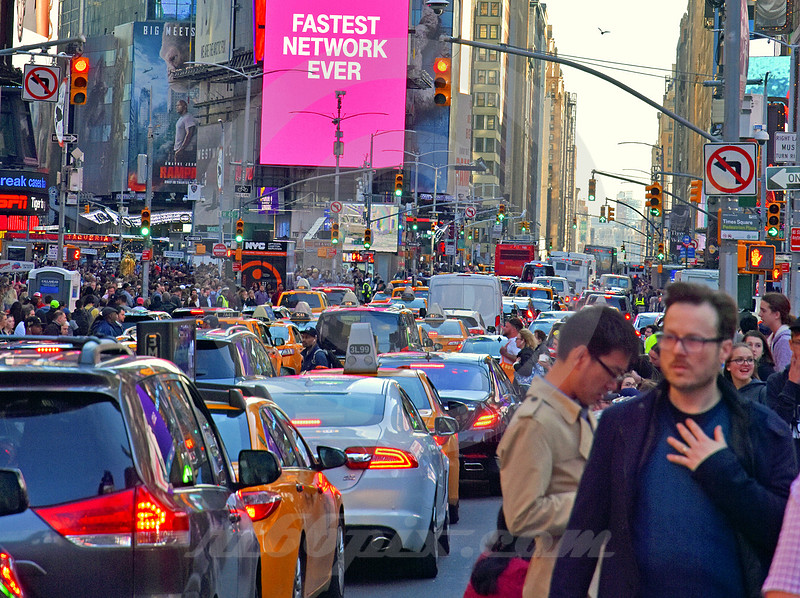
But only the bird moves freely. Even riding on the top deck of that distant red tour bus, on a vacation, would be an ordeal. The sidewalks are packed too, but it's literally faster to walk. Worst off are the cabbies who endure this all the time, and their passengers who watch the meter click away, charging for time instead of distance.
This is street photography, nobody is posed. The man in blue is probably a tourist responding to more of the same behind my camera.
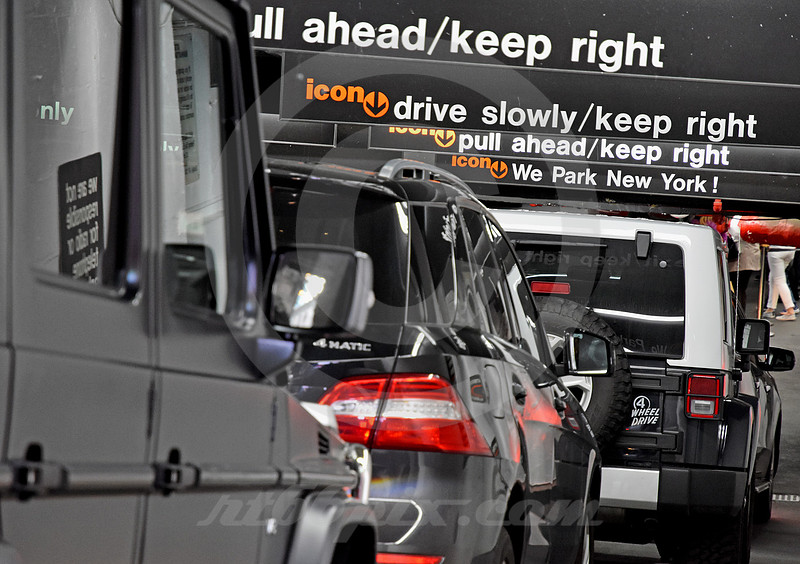
Here's another unposed unfortunate trapped in another part of town, waiting for somebody to please let his big hulking van cut into a long line of stalled traffic:

Maybe it was the same traffic jam, who knows?
It doesn't matter what vehicle you prefer--in New York I wouldn't have any. Where would you park it?
Nothing beats a cramped Subway car. Then you take a bus or walk.
- - - - -
My favorite image of New York commuting in snow is Erich Hartmann's "Girl in a Bus" from 1967, easily accessed on-line.
- - - - - - - - - -
CHRYSLER WITHERS: WHITHER CHRYSLER?
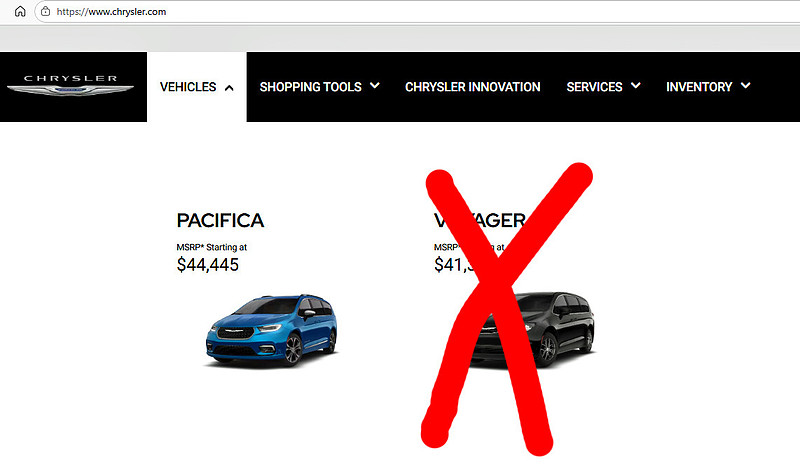
Have you noticed? (Probably not.) Chrysler no longer builds cars. The onetime flagship brand of the onetime Chrysler Corporation now offers only two minivans: Voyager and Pacifica.* OOOOPS: Make that just one minivan going forward, the Voyager is being killed off for 2027. Minivans are in serious decline and this version was introduced way back in 2016. Ten years is an awfully long time for a vehicle platform.
Plus Chrysler's Brand Manager suddenly quit "for personal reasons." Her duties were piled onto the guy already running Dodge. Sales of anything branded "Chrysler" are down 80% in 20 years. Chrysler actually sold MORE vehicles in 1955 (152K) than in 2025 (126K). But then, Studebaker's 1955 tally of 138K also surpassed Chrysler's of 70 years later.
Hmmmmm. Might be a clue here somewhere.
Chrysler's last car, the hulking rear-drive 300 ended production in 2023. A station wagon departed earlier. Perhaps you hadn't realized or cared. Chrysler is irrelevant, dying of neglect and starvation. But actually killing off the brand would dent resale values and perhaps trigger lawsuits from dealers and buyers. So instead we get this long goodbye: Automotive Alzheimer's.
Chrysler's Halcyon, Airflow and other concepts may or may not appear in showrooms. (You can't buy or drive a concept, and that was true long before AI.) The Airflow SUV at least has a date attached to it: 2028. Perhaps it will replace the ancient Voyager. Or maybe the equally old (but recently facelifted) Pacifica.
And parent company Stellantis could always re-badge something, transforming FIATs into Chryslers. (Hey, GM once turned the Chevy Cavalier into the Cadillac Cimarron!) You'd pay Chrysler money for a FIAT, wouldn't you?
Meantime the giant and relatively new Brampton Assembly Plant outside Toronto sits completely idle. One of its last models was the Chrysler 300.
The last original Chryslers were a generation back: the Concorde and LHS. Their efficient cab-forward designs bested anything in their class. Both were gone by 2004.
Before that was the Cordoba ending in 1983. Its "rrreeech Corrreeentheeean leatherrr" at least generated buzz. Chrysler "fusies" or fuselage designs of 1969-73 were...um, interesting but not hot sellers. Then we're back to fins, ancient history in automotive terms.
The one-time empire built by Walter P. Chrysler (1875-1940) is just about gone. It was sabotaged by incompetent leaders, rush-to-market engineering, sloppy assembly, and foolishly trying to compete head-on with GM--despite only a quarter of its market share.
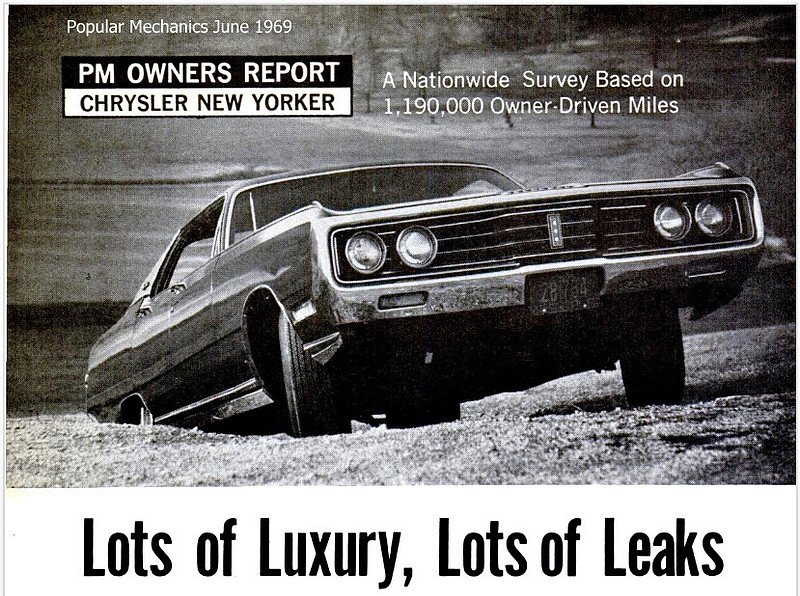
Walter P. was an engineering and management genius who saved Buick, then put his own name in chrome.** He built an auto empire trailing only GM in market share by the late 1930s (Ford had dropped to third). In ascending order the company offered Plymouth, Dodge, DeSoto, Chrysler and eventually Imperial.
Near the end, Lee Iacocca was a unique talent who kept the lights on during very dark times. In between, men of far lesser abilities warmed the leather CEO chair as Chrysler endured violent swings in sales and profits.
Structural weaknesses from the 50s onward combined with a "buyer be damned" attitude*** left the company on the ropes more often than a washed-up boxer.
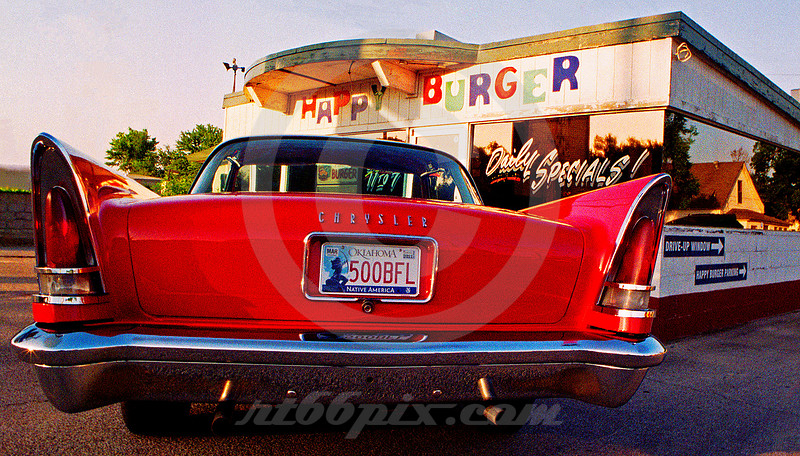
Chrysler Corporation's /6 engines, hemis, alternators, electronic ignitions, torsion bars and push-button transmissions were legitimate advancements. Fins and fusies were elegant designs at first, ruined by underlying problems.****
I make a case for Detroit's downfall beginning in 1957 with Chrysler Corporation products, especially Plymouth. Combine horror stories with wacky styling soon afterward***** and Mopar almost went to the junkyard in the early 60s. (See "Fin Means End in Latin" below.)
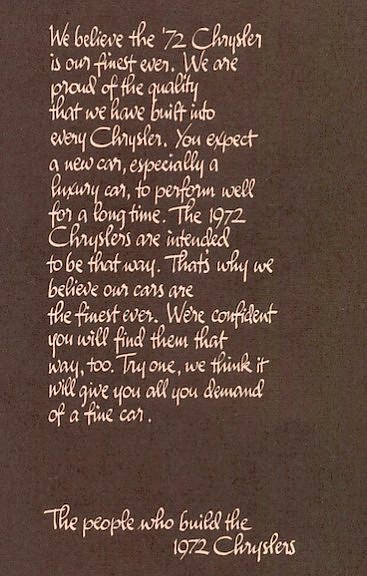
Blunders happened again and again under different leaders throughout the 1950s, 60s, 70s and 80s. Management's response to devastating stories about very real problems was to convene a special committee--not of designers, quality control engineers and the UAW, but of lawyers, PR-types and a calligrapher:
Finally came humbling loan guarantees and bailouts. But with help from first-to-market minivans, Dodge muscle cars, pickup trucks and Jeeps, the company sputtered toward the millennium.
Chrysler hasn't been controlled by Americans since 1998. It was taken over by the Germans of Mercedes, then the Italians of Fiat, and now the multi-nationalists of Stellantis, based in Amsterdam. Chrysler is a US and Canada brand, with little presence or name recognition outside North America.
If Chrysler gets scrapped, as I strongly suspect, only Dodge, Jeep and Ram will survive from the old Chrysler Corporation. And those names came from outside: Dodge Brothers and AMC. (Rams were called Dodge trucks until recently.)
Of the home-grown brands, the only long-term success was entry-level Plymouth, killed off in 2001 under the Germans. From the 1950s onward Plymouth never seriously challenged Chevrolet and Ford, but frequently was #3 in sales. Chrysler Corporation was weak where profits were strong: the middle and luxury segments. Successes were short and fleeting, done in by management, labor, and dealers.******
Chrysler hasn't really "stood" for anything since it re-introduced the 300 back in 2005. With it came changes that may have alienated traditional buyers. The design ripped off evoked Bentleys and early customers were from the upscale urban (hint: Black) market:
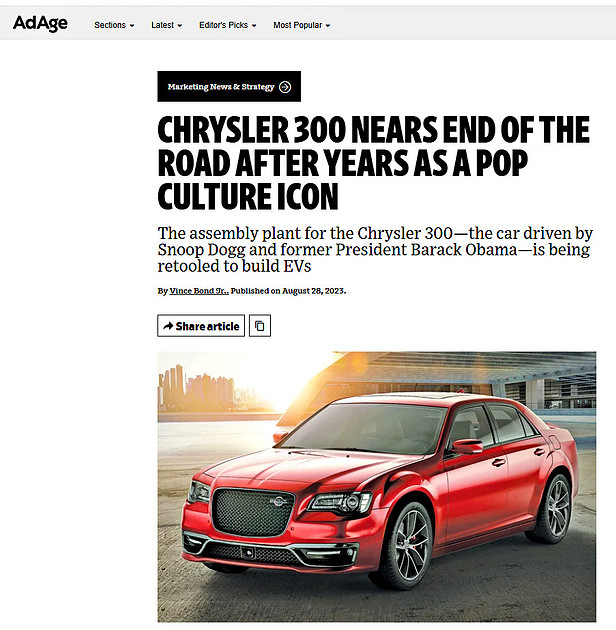
Chrysler had always courted middle-class suburban Whites******* with designs rivaling Oldsmobile--a far more popular brand GM killed off in 2004.
Turns out GM didn't need Olds, or Pontiac, or Saturn. And Stellantis doesn't need Chrysler. It has 13 other brands.********
- - - - -
* Until December 2024, this official website pictured new but unsold 2023 model 300s.
** And David Dunbar Buick, whose name adorned millions of upscale automobiles, died in near-poverty in 1929 unable to afford a phone, much less a Buick. He didn't even have Social Security.
*** Brake lights on the 1961 Dodge Dart were so small and oddly-placed that Chrysler Corp. was forced to offer additional retrofit lights. Owners paid for parts and labor. Today's heavy government regulation grew out of corporate evils like this.
**** /6 is the reliable slant six, hemis are powerful and efficient: both engines are legendary. Alternators and electronic ignitions spread industry-wide. Torsion bars did not. Push-button automatic transmissions (on dashboards left of the steering wheel) introduced in 1956 were safe and logical, but GM and Ford refused to adopt them. Fins could allow larger brake lights, but this potential safety advancement was squandered: not all vehicles got bigger lights in all years. (Some fins housed only a chrome strip.)
***** The 1957 DeSoto was clean and beautiful. The 1961 Plymouth (bottom of this page) was a hideous deep-sea creature on wheels. Chrysler's head stylist Virgil Exner created both. Then they fired him.
****** Chrysler and Imperial owners needing dealer service (perhaps because of persistent leaks) had to mingle with lower-class families getting their old Plymouths or Valiants repaired at joint dealerships. Because of much higher sales volumes, GM's middle-class brands and Cadillac typically had exclusive dealerships. Pontiac, Oldsmobile and Buick swamped the middle market, Cadillac achieved up to 80% of its class in some years.
******* Ridiculous euphemism alert! AdAge needed a way to point out that rapper Snoop Dog and Barack Obama are both Black, without actually saying "they're both Black" hence this stupidity. (And a generation or two back, weren't all middle-class suburbanites White?)
******** Come to think of it, the showroom looks pretty bare over at Dodge too.
("We believe" ad: Old Car Brochures. PR-types ("liars for hire") wrote this drivel and practically repeated the fifth sentence to pad out the lack of content. Although it's just printed flatulence, lawyers carefully vetted it to say absolutely nothing and make no specific assurances, representations, promises, guarantees, or warranties whatsoever, in elegant calligraphy. Consule Venditorem pro Singulis "see dealer for details", Ipso Facto, E. Pluribus Unum, Pro Bono, Carpe Diem, Semper Fi, Illegitimus non Carborundum, and especially Caveat Emptor!)
- - - - - - - - - -
SPARTAN DELUXE XLE
When I was growing up, Ford's Falcon was the economy car for the masses. And here's one now, in the lovely decorator shade of Appliance White:
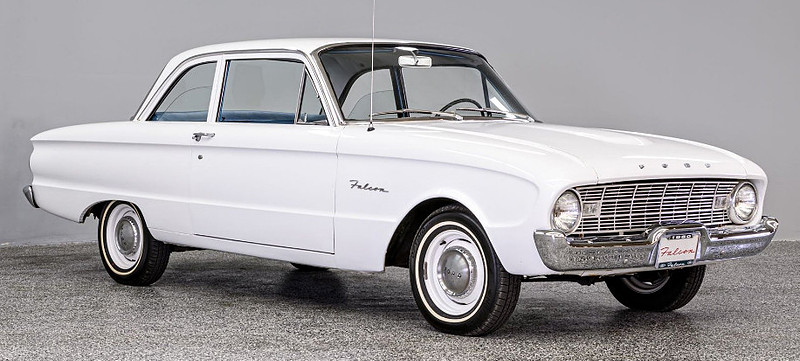
Introduced for the 1960 model year, the Falcon was intended to be the first new car for a sensible young person starting a career, or the second car for a family, useful for errands.
The Falcon had it all: white plastic knobs, painted metal dash, three-on-the-tree manual transmission, vinyl and nylon bench seats, room for six skinny people, practical rubber floors and bias-belted tires. Options included a single-speaker AM radio, two-speed automatic transmission, and padded dashboard. (This one has whitewalls and a whip antenna for a radio: the equivalent of XLE trim.)
No cows died to upholster the Ford Falcon. Leather, air conditioning, power seats, power windows, cruise control and carpeting were reserved for luxury and near-luxury cars back then.
Today you can't buy anything this spartan. In a few cases (like the two-speed automatic and bias-belted tires) this is a good thing. But how tough is it to crank a window...something we've been doing for generations?* As of the 2025 model year, crank windows are no longer offered on new vehicles in the US. The last holdout, Jeep's Wrangler JL dropped them after 2024, and almost nobody noticed.
We suffer from lifestyle-creep. Or maybe it's a thing: Lifestyle Bloat.**
Entry-level rides can be tricked out with expensive factory options. A nine-speaker sound system with subwoofer in a humble Toyota Corolla. Really?
Absolutely! See dealer for details.
Pickup trucks have gotten even more ridiculous.
A tougher generation than mine*** saw them as work vehicles. Heaters, visors and armrests were options. You could even buy a single aftermarket armrest for the driver's side and attach it yourself. The bench seats were painfully thin and covered with easy-to-clean oilcloth. Because.
Pickups are now rolling pleasure palaces. Options on the 2025 Ram include quilted leather, suede headliner, and 24 speakers. Some of these huge vehicles crash right through the six-figure barrier.
Falconesque transportation is no longer offered in North America. The market for simple cars and even simpler trucks--stripped of indulgences and excesses--doesn't offer big profits. But it contains a lot of people and could be exploited. The Model-T sold 15-million from 1908-27, the Falcon sold millions more from 1960-70.
Not long ago even Cadillac required some owners to crank their own windows!**** Have we lost that ability as a species in just a generation or two?
- - - - -
* The technology lasted more than a century. Crank windows appeared on some US cars before 1920. They were a handy solution to a problem created when Enclosed Cars replaced early open-top models.
** After the compact "Plymouth Valiant" came the oxymoronic "Plymouth Valiant Brougham."
*** Some young men managing ox-drawn wagons in the late-1800s plausibly drove early pickup trucks around 1920. The armrest was a luxury: it meant they were sitting and thus riding! In the wagon era, they typically walked alongside the animals. The trip from the US frontier to Oregon or California was 2,000 miles (3,200 km) or 4-5 million steps.
**** Crank windows were standard, power windows optional on the full-sized Cadillac Calais through 1966. And in the 1980s a small Caddy, the Cimarron, initially had crank windows with power optional.
- - - - - - - - - -
THE UNLIKELY ICON
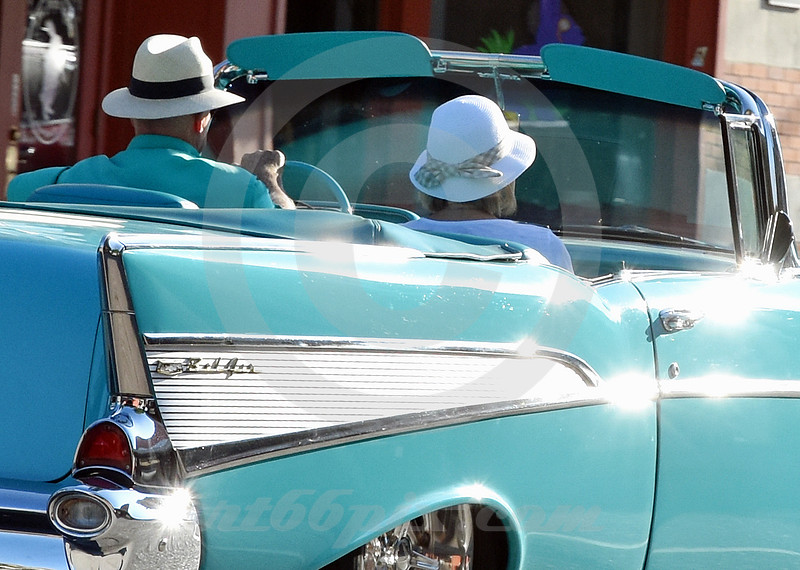
Cruising Route 66 in a 1957 Chevy...the road and car that have come to symbolize the 1950s.
Too bad the story is hopelessly jumbled, with this pretty picture adding leaded fuel to already-bad history. In 1957 both road and car had become outdated and ready for replacement. The Route 66 story is told elsewhere on the site. This is a companion tale about the car.
Today's pop-culture iconography gets it seriously wrong. The 1957 Chevy wasn't the best-selling vehicle of the 1950s--that was the 55 Chevy. The 57 Chevy wasn't even the best-seller of 1957! What the 57 Chevy was...was a solid disappointment.
While low-price rivals Ford and Plymouth unveiled all-new sheet metal that year, Chevy was still peddling the 55 body, warmed over for a second time. GM made more profit that way.
Because of its advanced age the 57 Chevy was taller and boxier. And attempts to freshen it were odd. The his-and-her hood rockets. The now-famous fins with chrome on the edge and (on top models) anodized aluminum along the sides.
The 55 and 56 Chevies had rounded pubescent fins with tail lights built into the top corners--a safe, pleasing, logical arrangement. But on the 57s, the larger pointed fins were empty, and lights were way down in separate chrome pods near the bumper. They looked like aftermarket parts: Open mouths contorted in sadness. We now have emojis like them.

Motor Trend panned the strange design as a safety hazard:
"The new low-set tail lights, smaller than most, do not give adequate protection against rear-end collision."
The combo of big empty fins with separate little lights was awkward at first glance, especially against the "clean" look of rivals.
Plymouth was the low-price styling leader that year with a windswept design ending in towering fins filled with lights. Ford was low and modern with graceful canted fins next to large round lights. Chevy was trying to pass off a two-year-old car with pointed but pointless fins as brand-new.

Or just maybe, possibly, not.
Chevy stumbled badly in 1957--and that makes what happened later so fascinating! For the model year, Ford jumped to #1, Chevy fell to #2. Plymouth cruised from #4 to #3, passing Buick. The earth moved under Detroit when sales were tallied.
On the basis of market share (which adjusts for changing market conditions), the 56, 58 and 59 Chevies were bigger hits with the public than the 57. So what happened to create iconic status today for a car that was an instant retro-ride for buyers and a setback for GM?
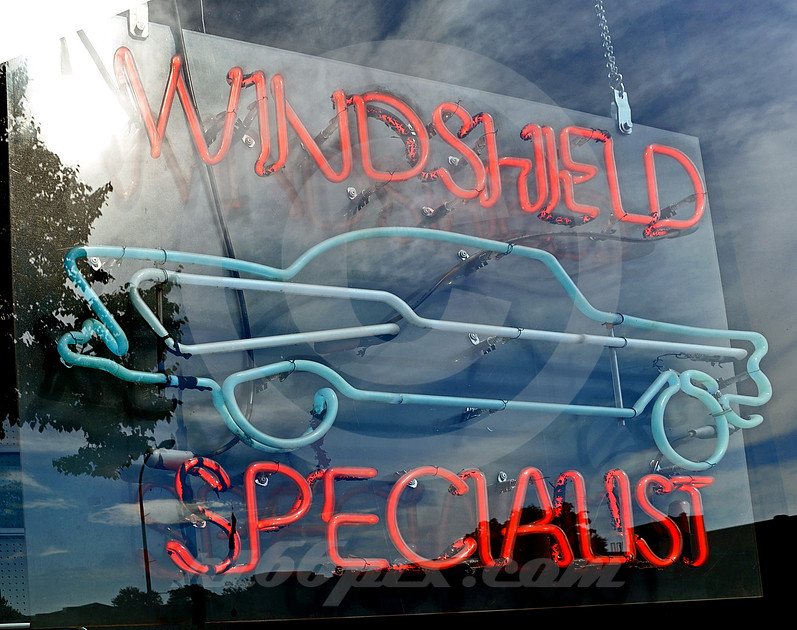
First, failures by the competition. The Fords were attractive and contemporary but Motor Trend found "startlingly bad" build quality. They rusted and had doors that could fly open on bumps. The Plymouths (as noted in an essay below) leaked in the rain, fell apart, and rusted prematurely. They were some of the worst cars ever produced--and that's saying a lot!
The Chevies lasted if they were reasonably cared for. Things fit and worked because many proven components carried over from high production in 1955 and 56. This parts availability also meant the 57s could be owner-maintained and later restored.
Second, wacky styling for several years afterward. It would be 1962 before Chevy offered a clean design. And longer still before anybody's family-hauler rivaled the tri-fives (55, 56 and 57) in value, respect, and loyalty. (Hint: Japanese.)
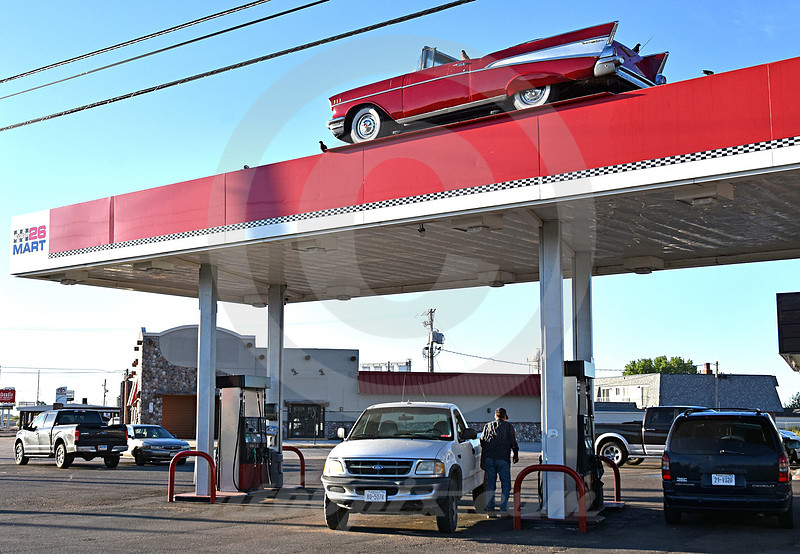
The 57 Chevy looks much better in retrospect. The design was odd then--but not today--because we're used to it. We've seen the future and it's nothing like what anybody envisioned in 1957...in sheet metal or anything else. Plus, unlike the main competition, it was a solid car. Chevy delivered value that year.
To paraphrase William Faulkner: 57 Chevies did not merely endure, they prevailed.
- - - - -
A follow-up: Detroit automakers lost their way in the 70s, and GM went bankrupt in 2009. They fully deserved it--good riddance to them and their anti-American values. The UAW was a willing accomplice and shares the blame. (Today's General Motors is legally a different company.)
Published in the Federation News by the National Historic Route 66 Federation.
- - - - - - - - - -
DETROIT DROVE ME FROM AMERICAN CARS
I pulled the handle, something snapped, and my car's mechanical door latch refused to open!
I pried off the inner panel and immediately spotted the problem. A little plastic thingy like a guitar pick had broken. It had three holes where metal rods hooked on. One rod went to each handle, the third to the latch.
A Chevy dealer had the part for an obscene $15. or so. It was scored near the ends--scientifically designed to fail--the old one proved it.
Somebody with a perfectly-named BS degree had engineered it to survive the 3-year/36,000 mile warranty...but not much longer. Enough hot-cold cycles and/or handle-pulls later, and it would snap as only plastic can. Imagine going to college for four years to accomplish THAT!
Fortunately it was simple to replace. A mechanic likely would have billed me for his lunch hour plus the part, but I was finished inside five-minutes.
GM, its dealers, the UAW and Mr. Goodwretch Goodwrench all benefited from this evil system. If enough little stuff started going wrong on an out-of-warranty car, folks might be tempted to buy a new one. GM, its dealers and the UAW would benefit all over again.
Anybody who owned a US vehicle from circa-1970 onward has (or had) horror stories. Most cost a lot more than $15. Anecdotally, Ford was just as bad, Chrysler even worse.
The engineering grad co-opted into this capitalist conspiracy is probably dead now. His tombstone should read:
He spent his useless wretched life in Detroit working for GM, subtracting value by engineering plastic parts to fail. For this he was sent straight to Hell.
That thingy is one reason why I haven't bought a Detroit product in this millennium. GM, which once had 55% of the US car market, went bankrupt...while I'm doing fine.
Detroit drove me from American cars.
- - - - - - - - - -
"FIN" MEANS "END" IN LATIN
Route 66 has its own Monument. Made from steel, it's on the Mother Road in front of the Convention Center in Tucumcari NM:
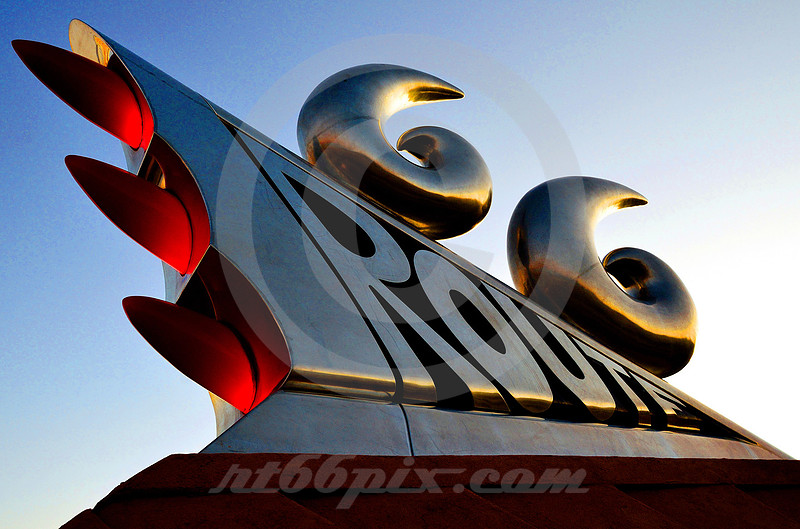
This is sculptor Tom Coffin's interpretation of a Chrysler Corporation fin...perhaps a 1958 DeSoto. GM and Ford never had a design like this.
You rarely see late 50s Chrysler products (Plymouth, Dodge, DeSoto, Chrysler and Imperial) at Route 66 car shows. They sold just fine, except for Imperial, but they were hastily-engineered rust-buckets. The (since closed) Walter P. Chrysler Museum outside Detroit tacitly admitted this on an overhead sign oddly illustrated with a 56 DeSoto. Problems started with the all-new 1957 models:
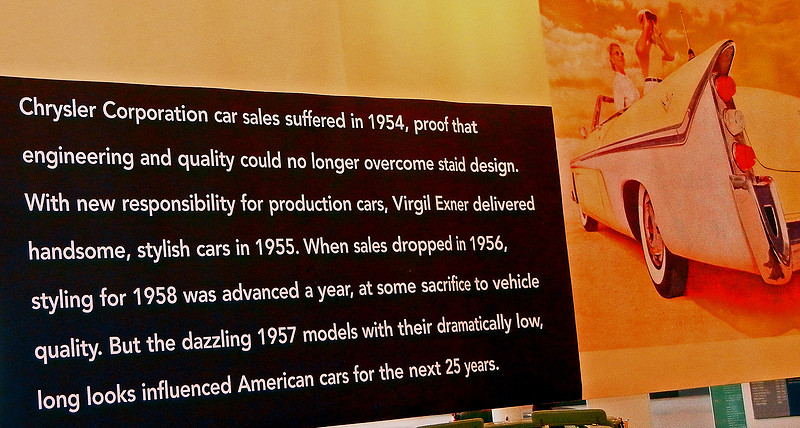
"Some sacrifice" indeed! The 57s were a rush job and hadn't been properly engineered. Other accounts have these cars intended for 1959 or even 1960!
When sales soared, quality control plunged with assembly lines and suppliers running flat out. The company paid a price--and buyers paid even more. There was plenty of "sacrifice" to go around:
"The 1957s started to rust within several months of being built--all models, Plymouth to Chrysler. They leaked water on both sides of the windshield posts on all models. Torsion bars broke leaving cars looking like fallen over Towers of Pisa. Upholstery split, seams tore, seat springs popped though, paint flaked off in huge chunks, hubcaps wouldn't stay on, rear view mirrors vibrated, door handles broke with ease, locks froze easily, and interior appliances fell off." --Curtis Redgap, Insider's History of Plymouth
This was an extremely short-sighted decision, and a Tipping Point in American business. Up until then, Chrysler had been known for solid engineering and boring styling. But suddenly the sizzle became more important than the steak. A 1954 luxury car, the Chrysler New Yorker Deluxe, is at left, while the entry-level Plymouth's top model, the Fury, is from 1957:
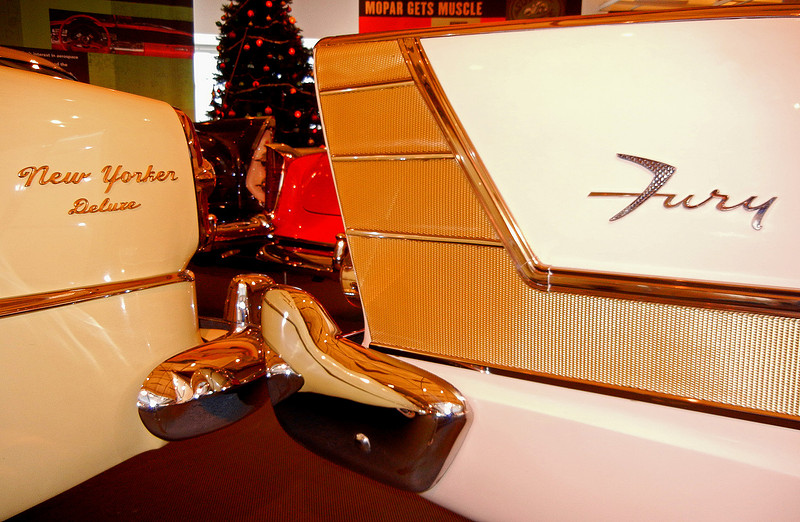
Fins didn't last, but Chrysler's newly-found reputation for problems did. Warranties were only 90 days/4000 miles back then--but all the claims helped push "Crisis Corporation" deep into the red for 1958.
"The biggest problem is that (the 57 Plymouths) were the worst cars Chrysler ever made. Quality was terrible so every car they sold made an enemy instead of a friend." --Dave Holls, "Collectible Automobile"
Chrysler Corp. entered the 1950s with 23% market share, behind only GM, and left it in free-fall, plunging below 10% by 1962. The pattern has continued since then with wild boom-and-bust cycles, near-death experiences, taxpayer-supported bailouts, and multiple foreign owners. Lots of forgettable-or-worse vehicles too: Aspen, Volare, Acclaim, Breeze, Dart, Omni, Horizon, Avenger, Dakota, St. Regis, Sebring, Intrepid. (Intrepid?)
Plymouth, #3 in 1957 behind Ford and Chevy, is gone now, along with Imperial. And we can't forget DeSoto either: the Fireflite, Firesweep and Firedome were all burnt toast by 1960 (below) as the brand was extinguished. (A few 1961 models were produced but didn't sell.)
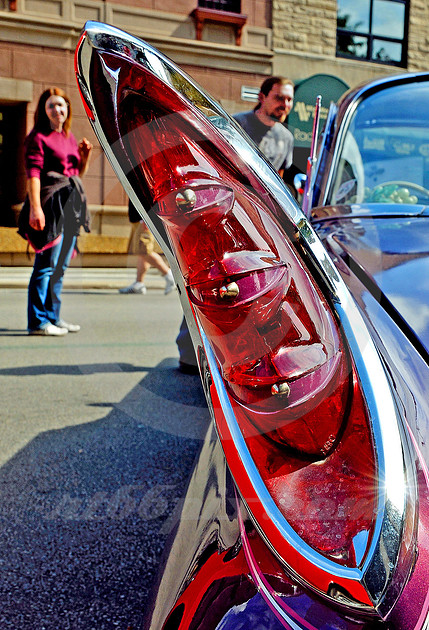
The fins that have come to symbolize Route 66 and "America At The Top Of Its Game" actually tell a very different...and very sad...tale. One era had ended and another was underway. From Solid Value to Planned Obsolescence. Steak to Sizzle. American Steel to Rust Bucket.
Finis.
- - - - -
Published in the Federation News by the National Historic Route 66 Federation.
Through a series of mergers, Chrysler Corp. disappeared into Stellantis, an Amsterdam-based firm with 14 brands. Surviving American brands include Chrysler, Dodge, Jeep and Ram (formerly Dodge) trucks.
- - - - - - - - - -
PARTING SHOT
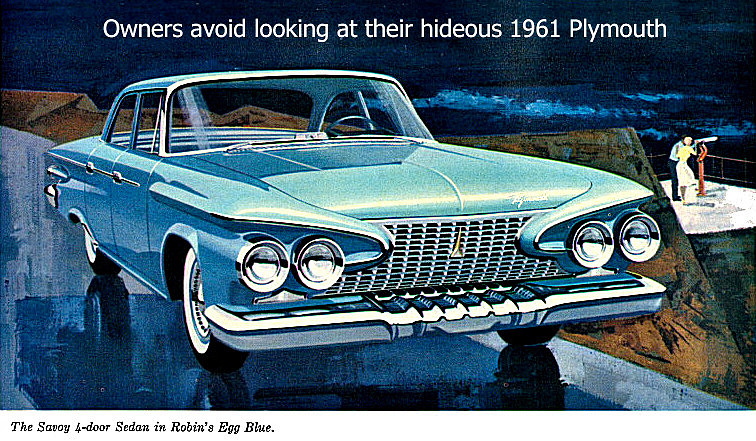
Give enough monkeys enough modeling clay and they will eventually come up with this. (The two-door hardtop was even uglier.)