


NOSTALGIA © www.rt66pix.com
Here's a good place to get nostalgic: the Bow Bridge in Central Park on a misty April morning. It appears in the gallery "New York: Manhattan Salute."
This is a companion page to "Preservation." We can't save what's gone, only mourn the loss. Permission is granted to link. Written material may be reproduced for non-commercial use only with appropriate credit.
- - - - - - - - - - - - - - - - - - - - - - - - - - - - - - - - - - - - - - - - - - - - - - - - - - - - - - - - - - - - - - - - - - - - - - - - - - - - - - - - - - - - - - - - - - - - - -
UNWORTHY CANDIDATES
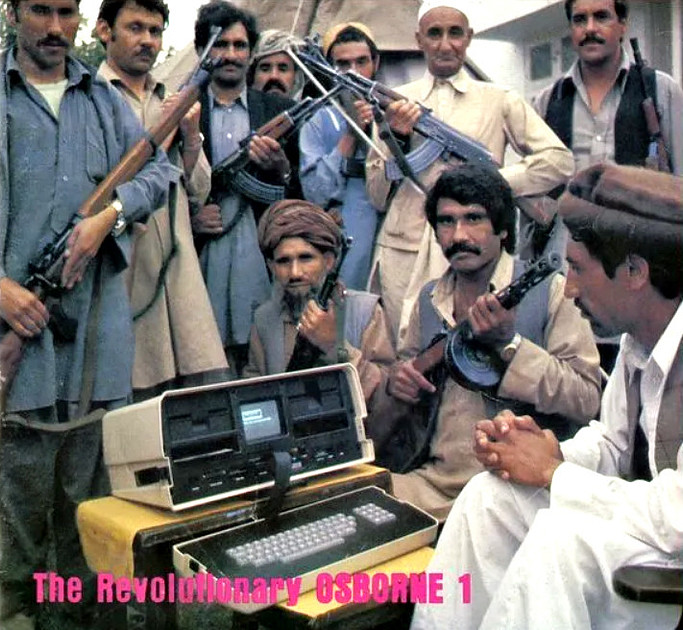
I sure don't get nostalgic for old technology! This was billed as portable in 1981 but weighed 24 pounds and had to be plugged into a wall socket. These gentlemen seem impressed with the generous 64KB of RAM and magnanimous 5" (12.5 cm) monochrome display--so we'll let them keep it. Besides, they have guns.
Somebody else will have to get all weepy and choked up over Sears, Monkey Ward, K-mart and Woolworth's. The same goes for shopping malls they once occupied. Next, think of all the restaurant chains that deserved to fail...and did, including Howard Johnson's and Po' Folks.*
We endured some terrible ideas. Best Products with its goofy "catalog showroom" ordering system. Giant cafeterias with pre-cooked food almost as old as the seniors lined up for it after church. Supermarkets trumpeting low low price specials, then gouging you on everything else. Trailways with a stewardess passing out magazines--on a bus!
But wait, there's more! Dixie beer! Nik-O-Lok pay toilets! S&H Green Stamps! Black and White TVs! The marketplace decided: they're gone but not missed.
Vinyl records and film may hang on, but I've moved on.
Nostalgia demands a higher standard...at least mine does. Hence the tributes below to pump jockeys and disc jockeys.
* Perhaps they should have merged into HoJoPoFo. But I digress.
- - - - - - - - - -
FULL-SERVICE: AN OBITUARY
(They were called "service stations" and they never got a proper burial, much less a memorial. This is a little late but it will have to do.)

His name was Bubba, or maybe it was Buddy. Locals have forgotten and it really doesn't matter anyhow. He could have owned the place and even lived here--a low-rent guy in a discount business.
He and his little adobe gas station were roadkill, doomed when the Interstate plowed across New Mexico way back in the 60s. All that right-of-way seized for the "public good" wiped out everything in its path, plus most of what was nearby. Route 66 got downgraded to an awkward frontage road, isolating and killing businesses like this relying on heavy traffic along its narrow old pavement.
What's left of Rt 66 is an open-air museum to mobility and obsolescence, a 2,400-mile (3,840 km) shrine to American change and progress. Nothing shows this better than the once-familiar gas station. It furnished software for the car's hardware, propelling us through the 20th century into the 21st.
The passing of the gas station era has been largely ignored in our busy change-filled lives. The utilitarian box that once proclaimed Texaco, Phillips 66 or just SAVE was repurposed long ago into a beauty parlor, souvenir shop or used car lot. Maybe it was knocked down for something bigger and supposedly better. Or maybe like this one it became a chicken coop then gradually fell down.

This stucco-coated adobe shed outside Newkirk NM was one of the original discounters. Rt 66 travelers pulled in here lured by signs on the front and both sides reading "5¢ SAVE 5¢." (Paint on one side remains barely visible in this 2012 image.) Inside seemingly at all hours was Bubba or Buddy--he may have slept on a folding cot. He opened near dawn and closed well after dark...when the headlights stopped coming.
Saving five-cents was big when gas averaged 20-cents a gallon. The national price--tax included--would stay there until after World War II. And that was back when folks might have to take odd jobs along the way to get their family and their jalopy hauling their entire "net worth" 1,500 miles (2,400 km) out to California.
Even later, in the prosperous and wasteful 1950s and 60s, the advertised saving on a 25-gallon fill-up might pay for a cold beer and grilled cheese sandwich at Carlos Place, a bar and dance hall nearby.
This little two-pump station was along the south side of Route 66 just east of Newkirk. The few people I could find didn't remember the brand--so they guessed. Shamrock? The flying horse (Mobil)? Another insisted it was no brand at all, which makes sense with the discount pricing.
Paper records kept by the county of 4,452 people offer little help--only that the "shed" existed in 1940 when Guadalupe County had twice the population. And the building was made of genuine adobe bricks, an ancient technology. Adobe was organic before organic was even a thing.

This gas station was just big enough for a chair and desk, maybe a heater using coal or bottled gas, today's propane. It had electricity for the tall gas pumps and surviving light fixture between them. So Bubba or Buddy likely had a lamp and fan, and maybe a small radio tuned, and turned, just right to pick up Albuquerque 140-miles (225 km) west.
There's no indication he ever had a repair shop, the money-maker in the gas station business. Whatever fixing went on took place out in the open, probably with just a screwdriver, wrench or tire-patching kit.
Even though this was on busy Route 66, it was a desolate spot on the shifting edge of the 1930s Dust Bowl with few local customers. Making things worse, both Tucumcari 32-miles (51 km) east and Santa Rosa 25-miles (40 km) west had gauntlets of gas stations. (In the 1960s Texaco would boast of five in Santa Rosa, population 2,220!)
Around the time this was built, the land started blowing away, and Bubba or Buddy was stuck here. Hard times hit a hard place: Newkirk NM is hot in the summer, cold in the winter, and windy year-round.
Locals don't remember him or his brand. They were all pretty much the same: pump jockeys, gasoline, oil, tires. Cars too, once they got old.
He may have built the shed himself, but the concept was used nationally. Discounters like Clark, Knox and Hudson all had little stations like this, made of brick, concrete block or metal panels. Adobe construction took longer, but the raw material was free. (Buck Atom's on Rt 66 in Tulsa is an old PEMCO station with the same design, just bigger.)

Let's say a battered Hudson Super Six with Oklahoma plates pulled in here during the late 1930s. How did the migrants, facing an unknowable future in a strange land still 1,000 miles (1,600 km) away, feel about the attendant? He had a job after all.
And he took their money like some fat-cat capitalist, adding it to the wad of grimy $1 and $5 bills in his pocket. The migrants' hard-earned change disappeared into the shiny but worn coin dispenser on his belt.
Did Bubba or Buddy pity these desperate refugees trying to reach California for the chance of a better life...or did he envy them? He must have known success would never come anywhere near him in Newkirk NM. At best he would survive to pump gas and scrub baked-on bugs off windshields another day. And another after that.
My guess is pity (and its evil twin envy) flowed both ways. Both groups were victims of forces well beyond their control and comprehension.

Novelist John Steinbeck likely would have seen this station in 1937 doing research while driving back to California to write his masterpiece The Grapes of Wrath about the migrants. He may have spotted a westbound family filling up here and pulled in to talk with them and the attendant, picking up dialect, anecdotes and local color.
His fictional Joad family left far eastern Oklahoma with $154 among the 13 people on board their 1926 Hudson, made into a crude camper with bad tires. Their average net worth: $11.85.
Chapter 13 of Grapes has one such encounter at a station almost 500 miles (800 km) back near Paden, Oklahoma, a "shack" with two pumps along US 62. The Joads buy six gallons of gas, mainly to get free water for their radiator and a drink for themselves from the hose.
As they commiserate and bond over hard times, parole-jumper Tom Joad tells the attendant: "You ain't got nothin'. Pretty soon you'll be on the road yourse'f." The man reluctantly admits Tom is right.
Newkirk NM lost a lot of folks during the 1930s when the grim "new normal" clamped hold. There was basically no safety net back then. President Herbert Hoover preached "rugged individualism" and "volunteerism" but they were inadequate and he was clueless. Unemployment nationally soared to 24.9% in 1933 just as Hoover was joining the ranks--tossed out in a landslide after a single term.
A big government construction project, the Conchas Dam 20-miles (32 km) north, provided jobs for some of the unemployed but apparently didn't spill over into prosperity here.
By the mid-40s, Newkirk's population had been cut roughly in half. The 1946 Route 66 travel guide by Jack Rittenhouse listed 115 people, four gas stations, two lunchrooms and a "trading post" or store. Today's population is eight and there is one unbranded gas station at the I-40 Newkirk exit. Lunchrooms and store are long gone.
Ties of family, friends and land can be hard to overcome. But anyone with most of their life still ahead had no reason to linger in Newkirk NM. When you found work you could write a letter back home. Or splurge on a three-minute Long Distance call after rates went down at night...if the folks back home had a phone.
Moving would have been absolutely the right decision. The people who deserved pity stayed behind. The attendant who topped off the Joad family's Hudson should not have envied them--he should have closed up and gone with them.

Not long after 1940, Adolf Hitler and Pearl Harbor did what President Herbert Hoover completely failed to do: put America back to work. Sixteen million young men and women went into the military and we suddenly had full employment.
World War II was very good for the US economy. The wheels had come off capitalism in the 1930s and We the People were forced to improvise. But with the nation producing for war, the Okies and Arkies who made it to California found employment in booming industrial plants. Soon, growers in the Central Valley were complaining they couldn't find laborers to tend fields.
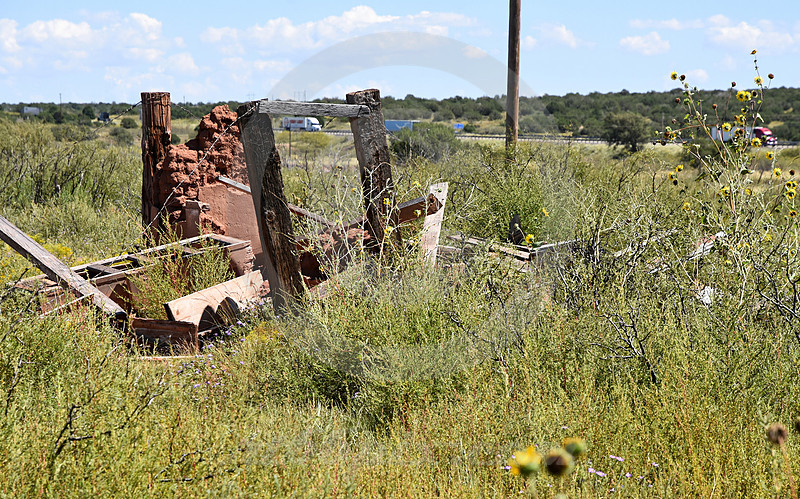
Generations have come and gone since then. We pump our own gas now. And the narrow overcrowded and deadly highway known as Route 66 has become a prime tourist attraction--a glorified and sanitized version of the past.
Bubba, or maybe it was Buddy, is gone too. Instead we have Buc-ees with 100+ gleaming self-service pumps, but no friendly attendant to perform his magic with a screwdriver and wrench. He disappeared, along with his little two pump adobe full-service station.
- - - - -
First image: William J. Lucas 1986, University of New Mexico archive. Others are mine, shown chronologically from 2012-2025. Tax records show this adobe "shed" was 10 x 11 ft (3.0 x 3.35 m), equal to a tiny bedroom. Wire netting around and over the former pump island indicates the final use was an animal enclosure--likely a chicken coop. Square logs are likely ties salvaged from the nearby Rock Island Railroad, abandoned in 1980. Traffic in the background is on I-40, so near and yet so far. And I captured a westbound Hobby Lobby craft store truck twice!
- - - - - - - - - -
PARADISE FOUND, PARADISE LOST
Can you get nostalgic for what you never experienced? For something that never existed? Such as California a couple of generations back portrayed by the state's entertainment industry: affordable Brady Bunch homes, perfect weather, palm trees, Beach Boys, California Girls...and the Summer of Love?
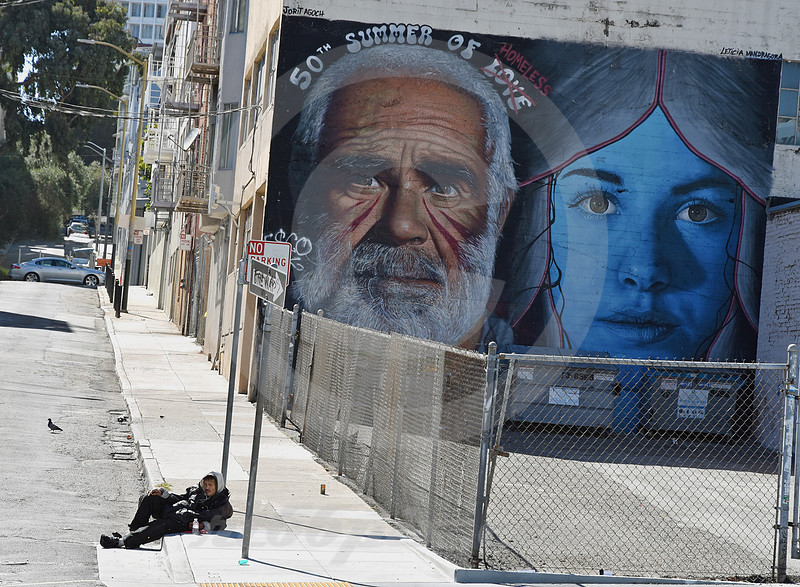
California seemed a place apart, too good to be true. Turns out that's what it was, just another ridiculous story from America's fiction capital. "California: the Sitcom State." Forces of destiny, destination and demography were about to shift here--almost like tectonic plates. (More about them shortly.)
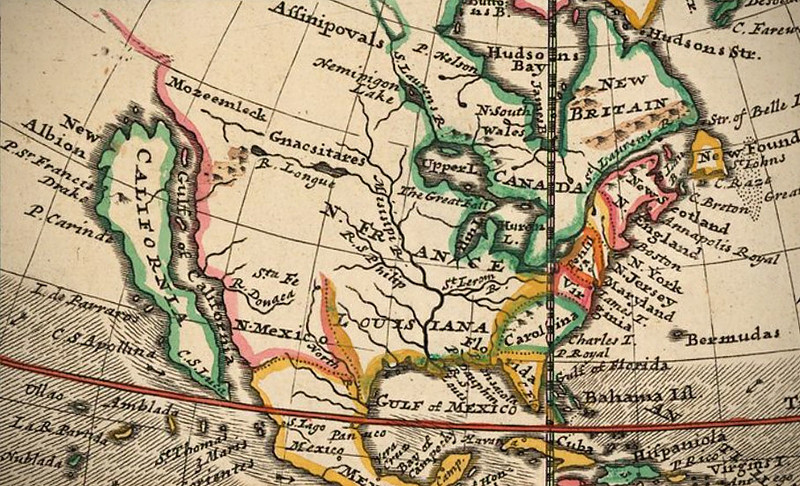
There's always been a sense that California was...um, different. In the 1600s it was an all-woman island ruled by Queen Califia who gave it her name.
200-years later, Richard Henry Dana Jr. became the first American to see the potential of the place, now on the mainland. In his classic 1840 book Two Years Before the Mast he exclaimed: "In the hands of an enterprising people, what a country this might be!" Then in 1971, Joni Mitchell sang it at the A&M Studios in Hollywood for a classic album: "Cal-ah-forn-ya!"
Between his prophecy and her high note was 131 years, not a long run for a paradise. Paradise...paradise...paradise? I remember now! It was that town I passed on CA Hwy 70 near Chico--the one wiped out by wildfire. Paradise was paradise...until it wasn't. The inferno roared for two weeks and claimed 85 lives.
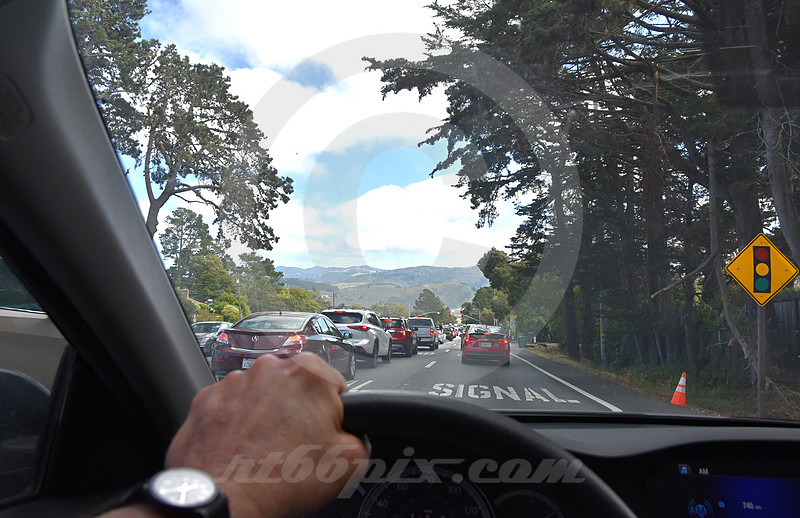
Now it's over, oh so over. Not just in Paradise, but statewide. While the plusses have plateaued, the minuses have mushroomed. For example: California may have more scenery than the entire country east of the Rockies. Here's some of it, just beyond the traffic jam on the Pacific Coast Highway.
Most everybody needs or wants to live in the same places--where the jobs are. This means apartments, starter homes, McMansions, stores, cars, freeways, the homeless, rampant graffiti...and crime...are crammed into relatively small zones.
California's population has almost doubled since 1970, the Brady Bunch Era, good-enough for a nostalgic benchmark. Remove half of the humans and the quality of life increases for everybody else.
But some problems are recent, self-inflicted, and there's no going back. That old map is partially right, California really is an island...for gasoline. The state's artisanal blend can cost double (or more) what drivers pay in other states. Going anywhere in California, even on open desert stretches of Route 66, triggers gas pains.
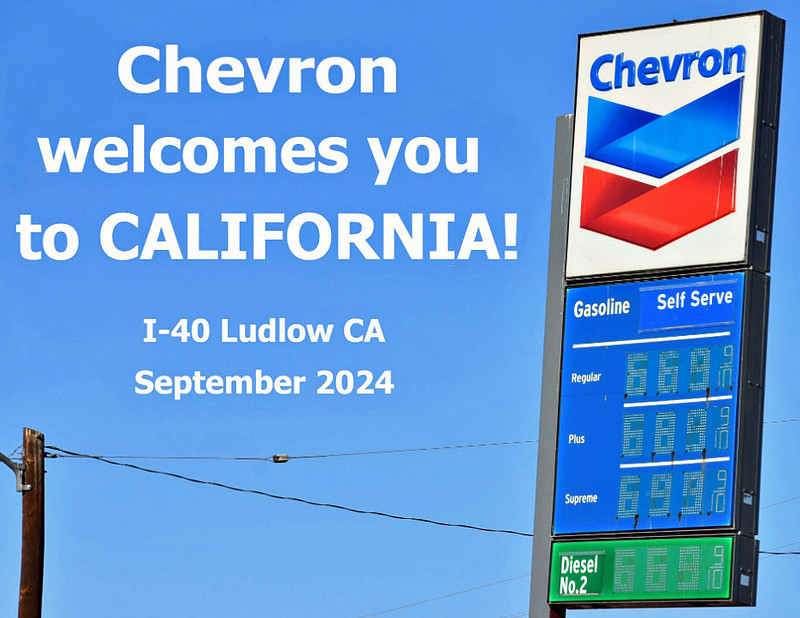
While this is extreme, typical CA prices are far above the national average. A wise inbound motorist fills up around Reno NV or Topock AZ.
The freeways are wide and always crowded. One Los Angeles radio station was doing traffic reports every six-minutes. All traffic, almost all the time. A San Francisco station was advertising tract homes "from the low one-millions." Or you could live farther out, perhaps in Sutter Creek.
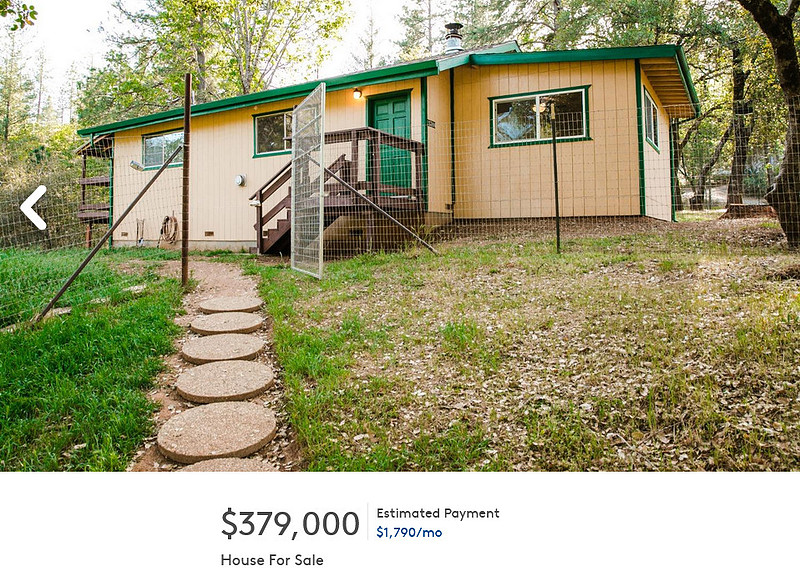
From this plywood palace, Sacramento is 45-miles away, a commute of one-hour 15-minutes according to Google.
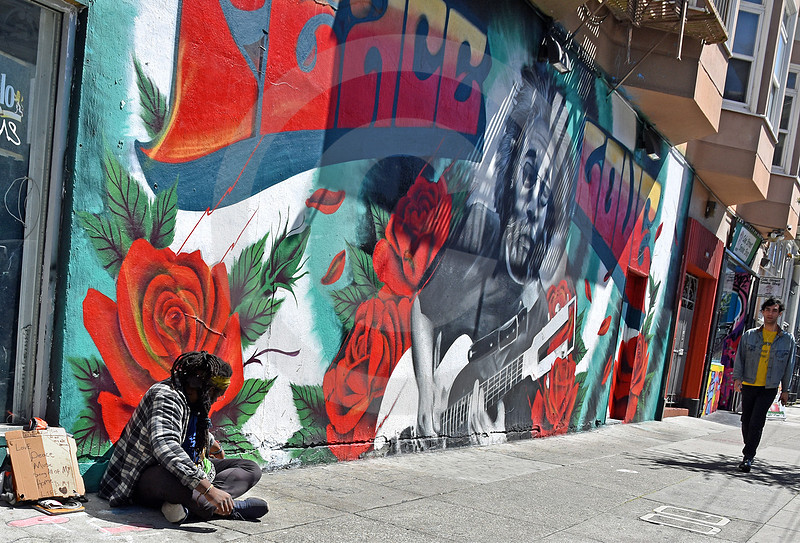
The homeless problem seems hopeless. Pleasant weather makes outdoor urban sleeping possible year-round, and not just near Los Angeles. Even San Francisco is mild enough, although rain protection is needed over the winter.

Did I mention that I don't sugar-frost things? (Yeah, I did.)
In some places "begging" appears to be a full-time occupation for healthy younger males, even when entry-level jobs nearby go unfilled. I suspect many could not pass a drug screening.
California is big in size but much is mountains or desert. Alpine County has only 1,200 people because it's largely vertical rocks. Other seemingly "empty" areas are actually highly productive farms or ranches, optimal use for that land. But the result is that half of California has almost nobody living on it.
Adding up all the haves and have-nots, California's population is just below 40-million (almost equal to Canada's). And most everyone is clustered around the Southern California coast, San Francisco Bay, and the Central Valley up to Sacramento.
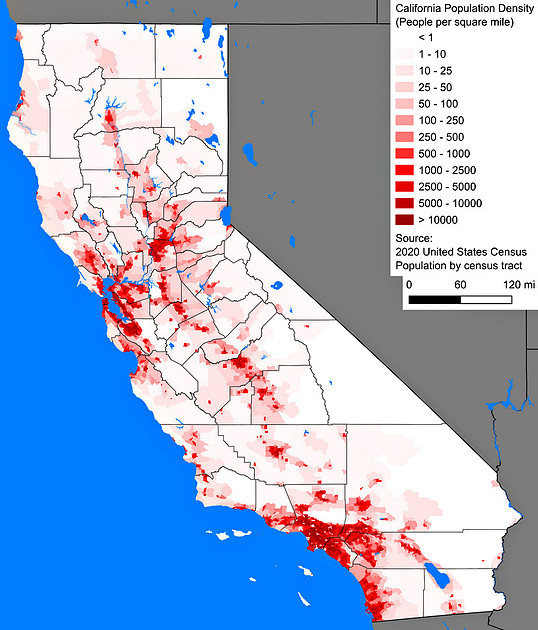
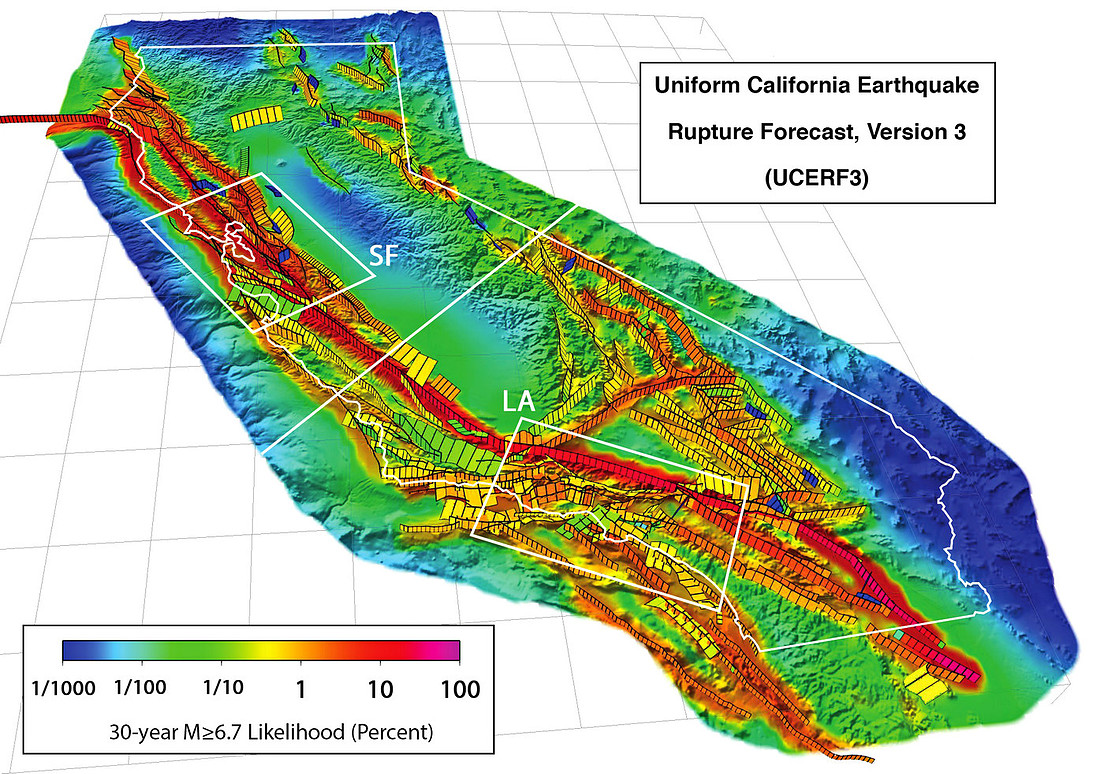
Now here's another interesting map, courtesy of the U.S. Geological Survey. These maps roughly line up, almost like people were magnetically pulled to two of the highest-risk areas.
This is interesting to look at, if you live far away in a "normal" state. Scenery and mild winters command a premium, as they should. But many Californians have determined the costs are no longer worth it, and are voting with their feet (or at least moving vans).
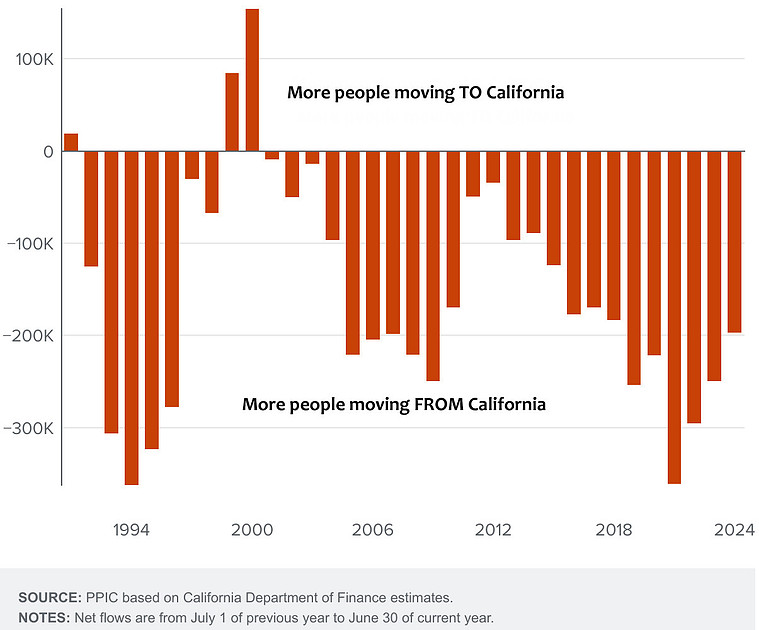
The state has suffered a net outmigration every year since 2000, and the rise of remote work could prolong this quarter-century trend.
To alter a famous line from 13-year-old Donner Party survivor Virginia Reed: "It ought to be a beautiful country to pay us for our trouble getting LIVING there."
Virginia wrote that as a new arrival in 1847, the year before gold was found at Sutter's Mill. Peak California may have been the Summer of Love in 1967, and the downward spiral began around when the Brady Bunch went off the air: 1974.
So 125 years, more or less. Not a long run for a paradise.
- - - - -
Notes:
. The public art mural by Jorit Agoch and Leticia Mandragora apparently is from 2017, the year before this image was taken. Graffiti mars the left edge just above the fence. This is street photography, the man and pigeon are unposed.
. The old map has great calligraphy, not so great geography. Fair maidens of Mozeemleck and Gnacsitares still long for conquistadors (and vice versa).
. The 1959 Brady Bunch home (used only for exterior shots) is in Studio City, northwest of downtown Los Angeles. A couple years back, it sold for $3.2 million. Other scenes were quaintly filmed (not videotaped!) at a movie studio. The sitcom aired from 1969-74.
. Urban photos: San Francisco city gallery, all taken in 2018.
. The Sutter Creek home ad is from 2022.
. Migration chart: Public Policy Institute of California, 2025, captioning added. The birthrate can overcome outmigration, but total population has dropped in multiple years.
. Virginia Reed's quote has been corrected for spelling and punctuation.
. Recommended but scary reading: A Dangerous Place by Marc Reisner. He notes a major quake could rupture earthen levees that have essentially become dams, protecting Central Valley land that has sunk as much as 25 feet (7.6 m) below sea level. If salt water gushed in, it could threaten much of the state's agriculture and the drinking water supply for millions.
- - - - - - - - - -
BAD LIGHTING, BAD BAD!
The beckoning light of the campfire and hearth is disappearing before our eyes. Our artificial replacements, the reading lamp and porch light, are being sacrificed to efficiency.
Incandescent bulbs, the Thomas Edison kind, give off a yellowish glow resembling sunlight and the outer light from fire. The effect is especially flattering on skin, and why candlelight dinners are so romantic. We are drawn to this light and have been since we dragged our knuckles (and romantic partners) into a cave.
Edison's bulbs have a filament glowing in a vacuum, cutting-edge technology for 1879. But just 5% of the electricity produces light, the rest becomes heat. Fluorescent bulbs introduced in 1938 produce a whiter more-efficient light. Some have an interior coating to approximate sunlight (perhaps Beijing on a high-smog day), but they're utilitarian and ugly.
Today's modern replacements, LEDs, are far superior to both in brightness, efficiency and longevity--but strident and bluish. They're great for flashlights and security lights but little else.
Lighting is a minor factor in typical home electricity bills. The incandescent bulb in a closet might be on 30-seconds a day, the fluorescent above a kitchen counter 30-minutes.
I prefer not to use fluorescents or LEDs for room lighting, but that option is rapidly disappearing. The bulb aisle is now a jumble of technologies, old and new, with wattage discrepancies. A "40 watt Soft White" is what I want...and will always want. I am forced to settle for (quoting from the box) "LED General Purpose 40 Watt Equivalent, 5 Actual Watts Used, DAYLIGHT NON-DIMMABLE Medium Base."
The light from this high-tech bulb is harsh, but it's for a rarely-opened closet so it doesn't matter. There will be no measurable savings (or effect on global warming), even over many many years.
This new bulb has a life rating, a type of Actuarial Table. And so do I. The bulb should outlast me, which (if true) would be the only benefit--I wouldn't have to change it ever again. Oh wait.
- - - - -
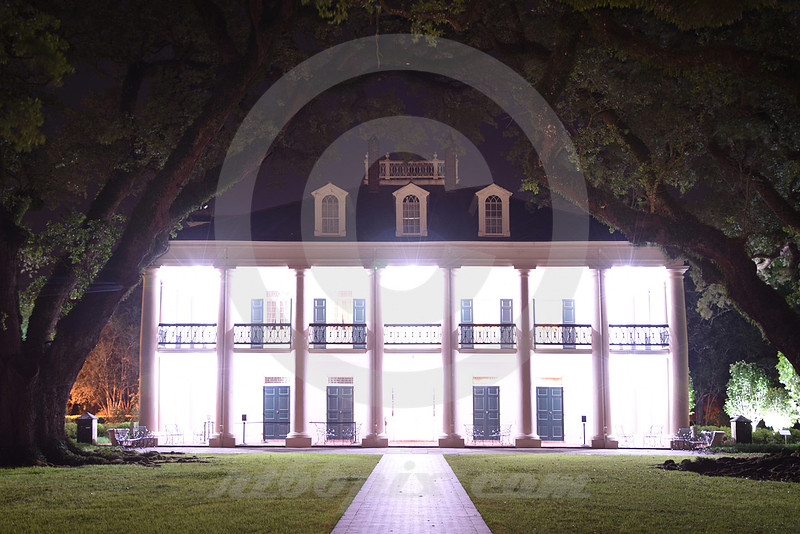
Oak Alley installed this horrendous gas station lighting which runs all night. This image appears only in the "QUICK! HIT DELETE!" gallery. Other photographs, relying on sunlight, are in the "Plantations: White Privileges" gallery.
- - - - - - - - - -
THE SOUNDTRACK OF ROUTE 66: AM RADIO

He seemed to live in our dashboard, a presence riding with us for hundreds of miles along the Mother Road. He always sounded upbeat, knew the time and weather forecast...and most of all: played our favorite songs. When he talked too much (or ran too many commercials) we pushed a button and he went away. No drama, no apologies, no long goodbyes.
He was the man on the AM radio, and today he hangs around waiting for retirement. Year by year as listening choices expanded, he gradually disappeared from our lives and our rides. But what a life and what a ride it was! Start to finish, it lasted more than a century.
Now is a good time to get nostalgic about AM radio, before it disappears like the once-great Packard automobile--not in a glorious flash, but in a gurgling flush.

AM is being targeted by automotive bean-counters who cut quality to add profit. It's shaping up to be a pitiful ending for a technology that contributed so much to our enjoyment of the Mother Road.
The Good Life once included a sharp new car with a push-button AM radio. Around 1965 it was an essential $57 option on the Mustang, adding 2.5% to the base price. All the sound came from a single speaker above the dashboard.

An AM-FM radio wouldn't be offered until later--soft tranquilizing FM music of the era could put drivers to sleep. But the world has been rearranged since pony cars. The Mustang came out long ago: 1965 is more than halfway back in time to the first Model-T produced in 1908. And with each passing year AM's audience is, um, tuning-out.
Tesla and other electric vehicle manufacturers already omit the AM band because electric motors cause interference. Ford tried to do away with AM in electric and gasoline-powered passenger vehicles beginning with the 2024 models. But it caved under pressure from Congress and perhaps static from potential buyers. Apparently, Ford figured most customers never listen to AM and wouldn't care. Sadly, that's exactly what the evidence shows.
1920S TECHNOLOGY
AM stations have always had one powerful advantage. Their muffled sound really travels, potentially hundreds of miles during the day, and thousands of miles at night. We learned this years ago as young adults driving Route 66.
AM radio used to be modern, right up there with paved roads and sliced bread. Radio broadcasting began around 1920, Route 66 was "invented" in 1926, commercial bread slicers in 1928, and the practical car radio in 1930.

AM was part of most any Route 66 trip. Network variety, comedy, drama and musical shows unified the nation during hard times. (FM and TV were only experimental.) AM brought us just about everything back then and for many decades beyond.
AM radio was the first technology to instantly span vast distances and reach a mass audience. It's hard now to realize how revolutionary that was. Newspapers had to set type, print and distribute copies--to be read by one person at a time. But now millions tuned-in to radio for news, sometimes from the scene, and frequently within minutes. This United Press teletype Flash and Bulletin, immediately read over radio, stunned the nation:

This news arrived as it was happening, while many Americans were in their cars and while our deeply isolationist nation was at peace. The Japanese raid on our naval base near Honolulu came on Sunday December 7, 1941 during the morning in both Hawaii and California. Japan declared war that afternoon. It made the papers (depending on your location) hours later that afternoon...or the following day.
Throughout World War II, radio led and newspapers followed. Since listeners had already heard the latest, papers were increasingly forced to provide background and supplemental material like maps. And at the very end in 1945, radio had the V-J (Victory over Japan) story exclusively for hours.

A RADIO IN ALMOST EVERY CAR
Gasoline and tire rationing prevented pleasure travel through the war, but then peace and prosperity took hold. Radio was a popular option in new cars, so eventually many used cars had them. The man in the dashboard was a constant companion--at least one station came in during the day everywhere on Route 66.
At night plenty of big stations boomed in. You could choose from network offerings, country acts out of Nashville or the dynamic new music coming from upstart studios in Memphis or Detroit.
Most of those sounds were on little records with big holes, developed by RCA in 1949. They played at a unique speed of 45 rpm, which RCA conveniently offered on new record players. There was one song to a side--perfect for radio stations--and 45s became the music industry standard. Record a hit song and you'd please both stations and buyers, since those "singles" were relatively cheap.

Sun Records founder Sam Phillips was a Memphis radio station engineer, and he purchased typical station equipment for his 1952 studio. His control room was Model-T simple, just enough to adjust microphone levels for the perfect mix and capture it on tape. All the magic happened on the other side of the double-glass where Elvis, Johnny Cash, Jerry Lee Lewis and Roy Orbison launched their careers.
Motown, established in 1959, was much more sophisticated and used a full bag of tricks. It turned the limitations of AM radio to its advantage through clever orchestration and mixing, doubling sounds, and propelling it all with drums. Part of its signature sound came from an attic speaker above the studio in an old Detroit house. A microphone at the attic's other end was wired into the control room, and the auditorium effect was blended in.
While Sun launched some incredible careers, Motown was a recording factory cranking out #1 AM radio hits--110 over a decade--as its Black artists crashed through to success, helping demolish racial barriers maintained by older generations.
Both Sun and Motown were AM-oriented. Their singles, played over low-fidelity AM radio, sold high-fidelity albums, and (from 1958) stereo albums. Low and high coexisted nicely for Elvis and the Motown acts, plus artists recording elsewhere, from Frank Sinatra to the Beatles.
NOSTALGIA TRIP
Perhaps you left Chicago for Los Angeles sometime in mid-century, driving Route 66 only in daylight. Big cities had plenty of stations, and even remote stretches had something to listen to. Most stations had a network or teletype service for news. All added value through music, weather reports, and commercials for a special little Rt 66 cafe with fresh strawberry pie.
Several Chicago stations reached St. Louis. A couple of St. Louis stations made it to near Springfield MO. One Springfield station reached Tulsa.

On the east side of Tulsa, Route 66 (11th Street) still goes by the three towers that used to be KVOO-1170 "The Voice of Oklahoma" where Paul Harvey got his start. Then came stations with good signals in Oklahoma City.
Driving across Texas, New Mexico and Arizona, radio was limited in the daytime and you had to put up with static. Amarillo and Albuquerque had early stations, and gradually smaller places like Tucumcari, Gallup and Kingman got radio too.
Flagstaff had struggling early stations, one at a time, with years of silence between them. But distant Phoenix came in along Route 66 through Arizona. Around Oatman AZ the big Los Angeles station KFI-640 began to overpower the static, although it was still 250-miles away. Eventually, as you started spotting palm trees, the dial was full.
NIGHTTIME IS THE RIGHT TIME
After dark, the AM band came alive! The sky was literally the limit with far-away signals twisting and distorting as they hit the ionosphere and bounced back. Theoretically, driving only at night, you could make it from Chicago to California on just one or two stations. This is the era many of us are...um, mature enough to remember.
Car radios of that time had mechanical push-buttons you would pull out to set. You might have selected these legendary AM giants.
ROUTE 66 ROCKERS
Chicago's "89 WLS" (as their jingles proclaimed) had several Golden Eras. The station was originally established by Sears, and the call letters stood for "World's Largest Store." Later, control passed to a farm publisher with shows like "National Barn Dance" and the always-popular hog report. Then in 1960, new owner ABC got things "all shook up" with rock-and-roll.
Despite what the farmers and other grown-ups predicted, the music turned out to have staying power and WLS dominated the Chicago market for it. At night you could typically rock with them into Oklahoma. Then, very possibly, you tuned from 890 way up to 1520.

Oklahoma City's KOMA punched above its weight. In the daytime it had a strong signal only in central Oklahoma. But at night it skipped up to Canada, down to Mexico, and out to California. Heading west on Route 66 after dark, you had to get into Oklahoma before it came in well, but then it would take you clear out to the promised land of Beach Boys and California Girls.
Finally, between Barstow and San Bernardino, Los Angeles-area rock stations started to appear: KFWB "Color Radio," KRLA in Pasadena...or the revolutionary KHJ. Starting in 1965 it muzzled the DJs, limited commercials, and pioneered short to-the-point jingles like "More Music 93 KHJ." By some accounts it went from worst-to-first in the ratings, and the format was copied at stations across the US and Canada.
COUNTRY ACROSS THE COUNTRY
Country music had (and still has) a home on the Grand Ole Opry, broadcast since the 1920s from WSM-650 in Nashville. Along Route 66, its signal would provide down-home companionship from Chicago to Albuquerque.
After radio had been around more than 50-years, a New Orleans station with another huge signal, WWL-870, discovered a new audience: all-night truckers. Beginning in 1971, its after-midnight show "The Road Gang" roared in along Rt 66 and the Interstates from Chicago to Flagstaff. Country songs dominated here too. It was live and relevant with updated traffic and weather nationwide, and many car drivers listened.
MEXICAN BORDER-BLASTER
Way up near the top end of the dial was a manic mess assaulting your ears and intelligence. XERF-1570 across from Del Rio, Texas had five-times the power of the biggest US stations. (The local audience was tiny, so it signed off for 12 hours during the day!)
There are a lot of stories about XERF...and some are even true. This English-language "border-blaster" was a jumble of aspiring country singers, prayer-cloth preachers, and rhythm and blues. It covered all of Route 66 from Chicago to Los Angeles at night during its heyday in the 60s, with DJ Wolfman Jack (real name: Bob Smith) pitching mail-order baby chicks, miracle ED pills, and other Good Life essentials.
YESTERDAY'S TECHNOLOGY TODAY
In the late 1960s, a few FM stations finally stopped playing numbing music for dental offices and went after AM's market-share of almost 100%. FM technology and reception improved, so more of us bought AM-FM radios as factory options. Eight-track tapes and cassettes came and went. Satellite radio started up and AM radio started down.
The AM band (now expanded to 530-1700) has been struggling these last several decades. Roughly 85% of the audience (it varies by market) listens to something else. A new type of network has emerged, with a different cast of characters (and villains). Many AM stations now run syndicated conservative talk that mainly attracts older listeners, unwanted by other advertisers. And station ownership has changed hands, perhaps multiple times. The mighty Route 66 call letters of yesterday have fallen...and can't get up.
Former AM titans WLS, KOMA, KHJ and WSM are marginal players in their home markets today. WWL remains a contender in New Orleans with a news-talk-sports format. XERF has been taken over by Mexico's public broadcaster.
No limited-range FM signals, satellite radio imitations or phone apps will bring back the legendary AM stations that were part of a Route 66 trip. They boomed in across long distances in the daytime, incredible distances at night, with just the push of a button. They kept us informed, entertained, awake...and alive.

Sorry if you are too young to have experienced this. AM radio sure was fun and important while it lasted. The technology was essential for 50+ years: the Soundtrack of Route 66, and the Soundtrack of Our Lives.
- - - - -
Updated from a version published in the Federation News by the National Historic Route 66 Federation.
Illustrations: 1) Deluxe radio in a @1960 Lincoln. 2) 1956 Caribbean with a sagging rear-end, the last year for "real" Packards (from Lincoln Highway CENTENNIAL gallery). 3) Dealer sticker for 1965 Mustang. 4) 1930 ad for a car radio. Crosley also owned WLW radio in Cincinnati. 5-6) United Press news read verbatim by radio networks and stations, a CBS recording exists. UP became UPI, United Press International, in 1958. 7) Sun Records control room looking into studio (from Memphis city gallery). Motown does not allow photography. 8) KVOO ad showing Tulsa @1940. 9) KOMA nighttime coverage map @1960s. 10) Can't decide between Betty and Veronica? Go out with both! (from Route 66 OKLAHOMA gallery).
Some stations and DJs live on through over-the-air recordings. They can be Googled this way: "KHJ aircheck 1965." Here's a video blast from the past, an in-studio minute of Los Angeles radio from 1988.
The same DJ appears in three solid hours of audio (his entire show) from KHJ in 1969 here.
- - - - - - - - - -
THOSE EIGHTY THRILLING WESTERNS OF YESTERYEAR
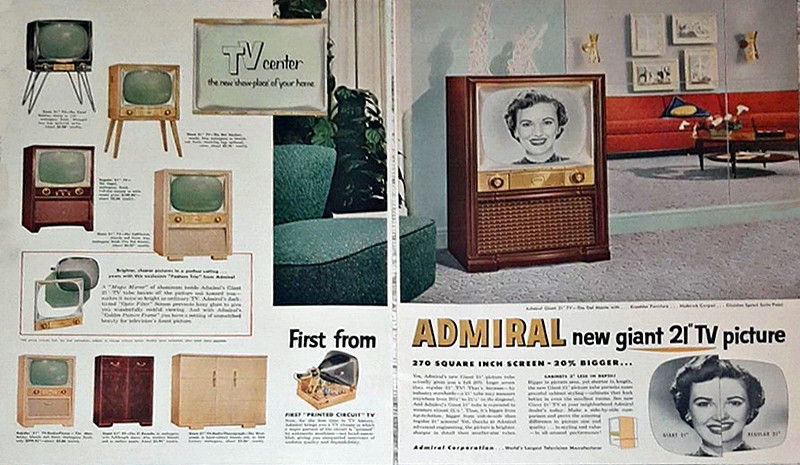
Today's kids have Tablets and TikTok, but we had TV Dinners and The Wild West! Television arrived at our house in late 1956 or 57. We didn't realize it at the time, but our magic Admiral living room furniture would transport us to the Golden Era of TV Westerns, filmed in glorious black-and-white.
We lived in suburban Detroit, with four (!) channels, all three US networks and an independent across the river in Canada. These shows were on, and I have underlined ones I remember watching:
The Lone Ranger, Roy Rogers, Gunsmoke, Have Gun Will Travel, Adventures of Rin Tin Tin (starring a dog), Cheyenne, Rawhide (starring Clint Eastwood), Wanted: Dead or Alive, Davy Crockett, Brave Eagle (starring Indians, one season, 1955-56), Zorro, The Virginian, Fury (starring a horse), Wyatt Earp, Maverick, The Rebel Johnny Yuma, The Gene Autry Show, The Lawman, Tales of Wells Fargo, Annie Oakley, Death Valley Days (sponsored by 20 Mule Team Borax), The Deputy (starring Henry Fonda), Hopalong Cassidy, Tales of the Texas Rangers, Wagon Train, The Adventures of Wild Bill Hickock, Sky King (a modern western with an airplane and the lovely Penny), Broken Arrow (Anglo-Indian friendships), Adventures of Jim Bowie, The Rifleman (began 1958), Bonanza (began 1959), Riverboat (co-starring Burt Reynolds, began 1959), Overland Trail (stagecoach line, began 1960), Outlaws (starring "bad guys" began 1960).
But wait, there's more! (We got that from TV too.)
Bat Masterson, Black Saddle, Boots and Saddles, 26 Men, Laramie, Colt .45, Adventures of Champion (another horse), Bronco (starring humans), Buckskin, Buffalo Bill, Jr., The Californians, Casey Jones, Cimarron City, Circus Boy (it was a Western circus), The Cisco Kid, Dick Powell's Zane Grey Theater, Frontier, Frontier Doctor (began 1958), Frontier Justice (began 1958), Hotel de Paree (set in Georgetown CO, began 1959), Jefferson Drury (began 1958), Johnny Ringo (began 1959), Judge Roy Bean, Law of the Plainsman (began 1959), Mackenzie's Raiders (began 1958), The Man from Blackhawk (about an insurance investigator!), Man Without a Gun, My Friend Flicka (a third horse series), Pony Express (more horses, began 1959), The Restless Gun, The Rough Riders (began 1958), Shotgun Slade (began 1959), Stagecoach West (began 1960), Steve Donovan Western Marshal, Sugarfoot, The Tall Man (began 1960), Tate (began 1960), The Texan (began 1958), Texas John Slaughter (began 1958), Tombstone Territory, Trackdown, Two Faces West (began 1960), Union Pacific (began 1958), The Westerner (Produced by Sam Peckinpah), Wichita Town (began 1959), Wrangler (began 1960).
Undoubtedly the list fails to include even more shows everyone has forgotten. This Western windfall--three networks filled with 80 shows--lasted into the mid-60s although Bonanza ran until 1973. Like other things in life, the Golden Era became apparent only after it was over. (Many shows can be watched today on TV sub-channels, cable or DVDs.)
There were no guns in our house, our parents didn't even want them on TV. So we were not allowed to watch some shows, like the badly named Gunsmoke. It was set in Dodge City, on the high dry plains of southwestern Kansas during the 1870s.
I saw a couple of episodes recently, just after I had been in Dodge City photographing along the Santa Fe Trail. The area is as flat as my desk with only occasional small bumps for landmarks. But outdoor filming for Gunsmoke took place in the dramatic scenery of southern Utah, a disconnect so ridiculous I laughed out loud. We definitely weren't in Kansas anymore!
Everything on Gunsmoke was fictional, revolving around the main characters (Marshal Matt Dillon, Miss Kitty, Chester, Festus and Doc) instead of accurately portraying history...or geography. Most episodes had a life lesson of sorts, and that was true of all the shows. It was nice escapism during long Michigan winters. And it kindled my wanderlust--a desire to see where exactly that scenery was.
14-hours from Dodge City by car, as it turns out...even longer via horse or stagecoach. Scenes from The Lone Ranger were filmed in Utah too. While both were shot in black-and-white, the area is far more impressive in real life...what NBC (our Channel 4) used to call Living Color.
Also around this time, a lone cowboy galloped in, creating a cloud of dust and second-hand smoke, starring in his own show for adults and teenagers--brief but incessant episodes of Marlboro Country.
At first this cowboy was one of several implausible heroes smoking a sissy filtered cigarette formerly marketed to women. The other he-men, including an orchestra conductor with a tattooed hand, were lame and quickly canned.
But Marlboro's cowboy (actually dozens of men) stayed on the air until 1971 when TV advertising for cigarettes was finally banned. The Marlboro Man was probably better-known than any star of the 80 shows, showing how the long-vanished Wild West influenced pop culture in that era for children and adults.
- - - - - - - - - -